


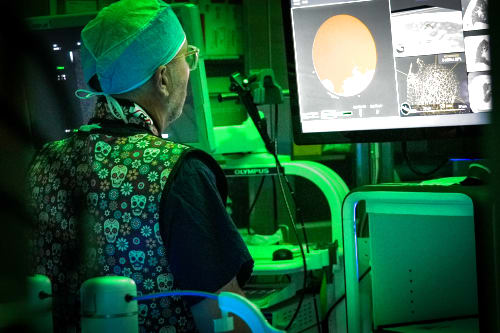
November marks Lung Cancer Month, a time dedicated to increasing awareness of lung cancer, the leading cause of cancer-related deaths in the United States. According to the American Cancer Society, more than 226,000 new cases of lung cancer have been reported so far in 2025.
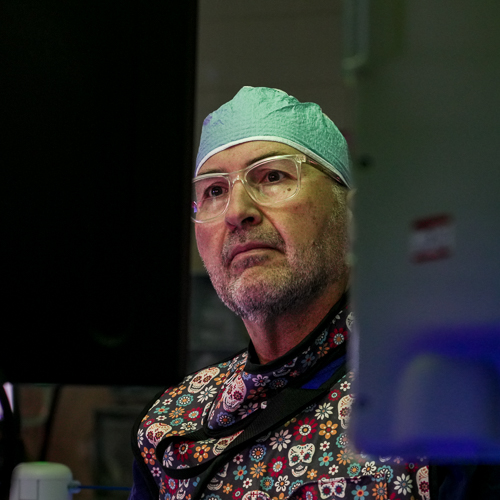
While lung cancer remains a deadly disease, the number of new cases continues to decline, partly due to fewer people smoking or starting to smoke, as well as groundbreaking robotic technologies that have transformed how medical professionals detect and treat lung cancer.
As with many types of cancer, early detection is critical for improving health outcomes, and advances in robotic technology have become essential tools in the early screening and treatment of lung cancer. Before this technology, lung cancer detection relied on a traditional “manual” bronchoscopy process to biopsy small lung nodules. However, this method often produced suboptimal results, prompting medical teams and researchers to develop and adopt innovative robotic technologies.
Now, robotic bronchoscopy, often referred to as robotic-assisted bronchoscopy (RAB), enables healthcare teams to biopsy smaller nodules in hard-to-reach areas of the lungs. By using robotic bronchoscopy, doctors are able to examine a patient’s airway to identify lung cancers and other lung diseases, leading to faster diagnosis, more effective treatment, and reduced risk of disease progression.
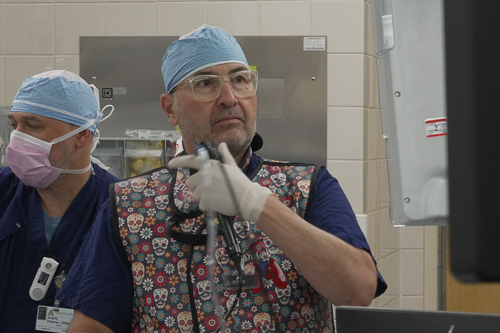
At Berkshire Health Systems, we use a state-of-the-art robotic bronchoscopy machine that has been instrumental in detecting small lung cancers in hard-to-reach areas of the lungs. Since launching our lung cancer screening program in 2013, it has grown significantly, from 300 scans the first year to over 3,500 in 2024. We continue to advance lung cancer treatment through innovative therapies and technologies, including this cutting-edge robotic system.
Achieving an earlier diagnosis leads to earlier treatment and better outcomes, but there are still steps you can take to keep your lungs healthy. The most effective way to prevent lung cancer is to stop smoking. In fact, 80 – 85% of lung cancer cases are linked to smoking. Other factors, such as genetics, secondhand smoke, and environmental exposures, can also increase your risk, but smoking remains the leading cause of lung cancer.
If you are over 50 and smoke, you may be eligible for a low-dose CT chest scan as part of a lung cancer screening, which can be arranged with your primary care physician. Among roughly 10,000 patients enrolled in Berkshire Health Systems’ lung cancer screening program, only about 4% require a biopsy or other invasive procedures. Act now – the sooner you receive a lung cancerscreening, the sooner medical teams can detect and treat cancer in its early, more manageable stages.
-
Your lung health matters.
Your lung health matters. The best way to reduce your risk of lung cancer is to be proactive and take care of your lungs.

Massachusetts QuitWorks
The Massachusetts QuitWorks helpline is a service that assists MA residents that would like to quit or cut down their tobacco or nicotine use.
Don’t hesitate to call today: 1-800-QUIT-NOW.

Would you like to learn more?
Berkshire Health Systems Surgical Services’ clinicians are here to guide you through any surgery, from pre-surgical preparation to recovery and rehabilitation.
Learn more