
A standing room only audience gathered at Berkshire Innovation Center for a wide ranging discussion on the state of health care, as community stakeholders, BHS President & CEO Darlene Rodowicz and Congressman Richard E. Neal (D-Massachusetts) convened to examine the growing pressures facing patients and providers alike.
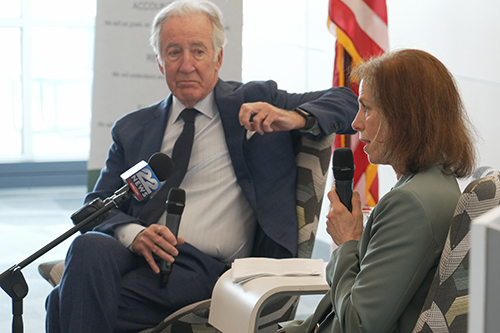
The conversation focused heavily on the consequences of recent federal health policy decisions—from the expiration of enhanced Affordable Care Act premium tax credits to deep cuts across the healthcare industry—and what those changes mean on the ground for families, hospitals, and local economies.
“I’ve not given an inch on our hospitals. This is how families make decisions to locate, this is how businesses grow around the ancillary services that come, the process for goods and services that are bid that come out of it,” Neal said to nearly 100 community leaders gathered at the Berkshire Innovation Center. “More than 4,000 people work at Berkshire Health Systems. That’s an astounding number for a relatively small community, but it’s also [a system] of stellar reputation. That’s the big deal.”
Coverage Losses Already Being Felt
Neal and Rodowicz pointed to early data showing that millions of Americans are projected to lose health insurance following the expiration of enhanced ACA premium tax credits and the implications of the One Big Beautiful Bill Act (OB3), passed in 2025. According to the discussion, some individuals have already chosen to go uninsured, while others have shifted into high deductible plans that expose them to significant out-of-pocket costs.
“The way we’re going about it really chops people up at the knees and comes at one of the worst times for health care, which is still experiencing workforce shortages. The part that bothers me the most about this bill is the majority of the cuts don’t happen until this fall, when the midterms are done,” Rodowicz said. “That’s by design, and that’s when the big hits come….”
Hospitals are bracing for increased uncompensated care, service reductions, and difficult staffing decisions as financial pressures mount.
Rodowicz and Neal described how coverage losses and funding cuts are already forcing tough decisions nationwide—closures of maternity wards, reductions in mental health services, and layoffs that ripple beyond hospital walls.
“We are still one of the few places, I think, in the country that has actually reopened a hospital. A lot of them are doing standalone emergency services, but not full hospital care,” Rodowicz said. ” And I will say that the care is different in North County now that we are a full licensed hospital [North Adams Regional Hospital].”
‘Pay More, Get Less’
The discussion also addressed recently proposed Republican health care plans, which were characterized as shifting Americans into skimpier coverage while increasing personal financial risk.
“The emergency room is a bad way to get health care, and it tends to evoke a lot of emotions in the emergency room, and it creates a lot of tension in the emergency room,” Neal said. Republican plans ultimately create the unintended problem that “people who are worried about losing their health care, they stop showing up anywhere until they have an emergency, so they postpone diabetes treatments. They postpone hypertension, which is linked to diabetes. They just don’t go. They avoid their doctor as well, and then they end up in the emergency room with a much bigger problem.”
Berkshire Medical Center alone sees about 50,000 ER visits per year, some people use the department as a primary care provider because they have a hard time getting to a doctor’s office, Rodowicz reported. “It’s a very busy emergency department. It rivals what happens in large urban areas, quite honestly,” she said.
What is BHS doing to prepare for these changes? Rodowicz said it is about remembering the organization’s mission of advancing health and wellness for everyone in the community. “And if we’re true to that mission, we don’t plan on closing our doors or saying no to anyone who shows up.”
Speakers stressed that medical debt is not just a personal hardship but an economic one, affecting workforce participation, small businesses, and local communities.
A significant portion of the conversation focused on nationwide healthcare workforce shortages, particularly in rural regions. Rodowicz highlighted BHS’s investments in career pathway programs, training initiatives, and recruitment efforts designed to keep care close to home.
“We’ve had to be creative and nimble,” Rodowicz explained. “That means investing in people—training them, supporting them, and giving them a reason to stay.”
Access to primary care emerged as a recurring theme, with speakers emphasizing its role as the foundation of healthy communities and a stabilizing force for the broader health system.
Federal Uncertainty Looms
Uncertainty surrounding federal funding, Medicaid policy, and programs like 340B drug pricing program cast a long shadow over the discussion. Speakers warned that while short term relief funds can help, they are no substitute for sustained investment and stable policy.
“You can’t patch a trillion dollar cut with a onetime grant and call it a solution,” Neal said. “Hospitals need predictability to plan, invest, and care for their communities.”